A Prophecy Fulfilled
On a Friday in the month of Ṣafar, in the year 16 after Hijrah, something extraordinary happened in the heart of Persia. Ḥaḍrat Sa'd ibn Abī Waqqāṣ (RA) placed a minbar in the White Palace of the Persian emperor and led the first-ever Jumu'ah prayer on that royal soil.
This was not merely a military victory. It was the fulfillment of a divine prophecy and the symbolic transition from the darkness of fire-worship to the light of Tawḥīd—the Oneness of Allah.
What Was Madā'in?
Madā'in, meaning "The Cities," was a collection of ancient urban centers near present-day Baghdad, Iraq. It served as the capital of the mighty Sassanid Persian Empire, a civilization known for its grandeur, wealth, and centuries of dominance.
At the center of this empire stood the White Palace (Qaṣr al-Abyaḍ)—the residence of Kisrā, the Persian Emperor. This palace symbolized Persian power, sophistication, and the pride of an empire that had stood for generations.
For the Muslims, Madā'in represented more than a strategic target. It was the heart of a civilization that worshipped fire and rejected the message of the prophets. Its conquest would signal the end of an era and the beginning of a new chapter in human history.
The Road to Madā'in: Faith Over Fear
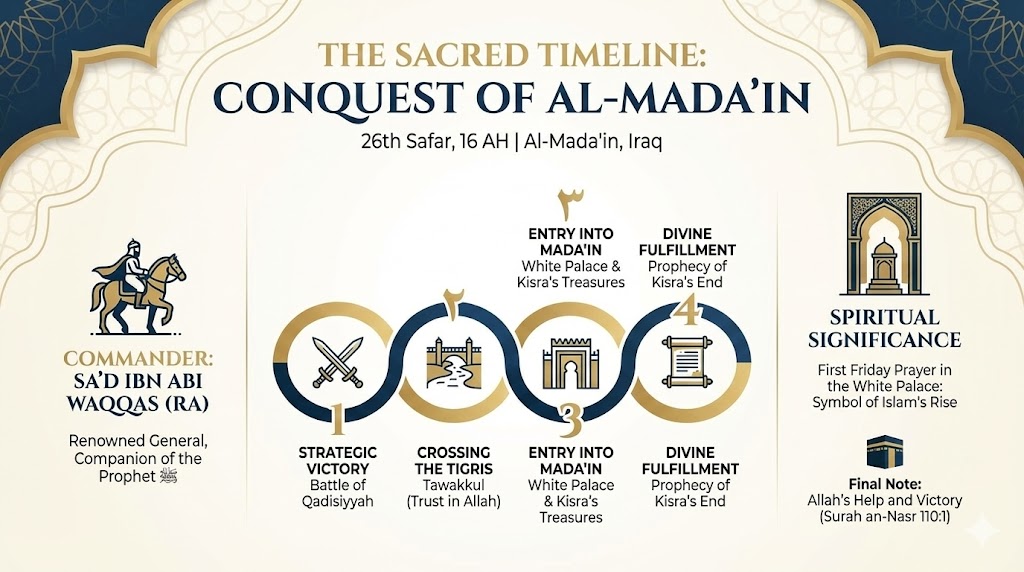
The commander of this historic campaign was Sa'd ibn Abī Waqqāṣ (RA)—one of the ten companions promised Paradise, a close confidant of the Prophet ﷺ, and a brilliant military strategist.
The path to Madā'in was paved by the Battle of Qadisiyyah in 15 AH, one of the most decisive confrontations in Islamic history. Despite being outnumbered and outmatched in resources, the Muslim army achieved a stunning victory over the Persian forces. This triumph opened the road to the empire's capital.
But reaching Madā'in required crossing the Tigris River—a formidable challenge. The Persians had destroyed the bridges in retreat, hoping to halt the Muslim advance. Undeterred, the soldiers crossed on makeshift rafts, and some even swam across, their armor weighing them down, relying entirely on tawakkul—complete trust in Allah.
This moment of crossing epitomizes the spirit of the early Muslims: limited resources, overwhelming odds, but unshakeable faith.
The Fall of an Empire
When the Muslim army reached Madā'in, they found the city abandoned. The Persians, gripped by fear, had fled, leaving behind the legendary treasures of Kisrā. No major battle was fought inside the city—the conquest was swift and bloodless.
Inside the White Palace, the soldiers discovered immeasurable wealth: royal crowns, jewel-encrusted swords, silk garments, and artifacts of breathtaking craftsmanship. Among these treasures was a famous ornate cloak belonging to Kisrā himself, which was later sent to Caliph 'Umar ibn al-Khaṭṭāb (RA) in Madinah.
But what moved 'Umar (RA) was not the wealth—it was the humility and integrity of the Muslim soldiers. Despite the immense riches before them, they did not take anything for themselves. All wealth was gathered, and after the obligatory khums (one-fifth for the Bayt al-Māl, the state treasury) was set aside, the remainder was fairly distributed among the mujāhidīn.
This discipline and fairness in the face of temptation set the Muslims apart from conquering armies throughout history.
The First Jumu'ah: A Spiritual Victory
On the 26th of Ṣafar, 16 AH, Sa'd ibn Abī Waqqāṣ did something deeply symbolic. He placed a minbar—a pulpit—in the White Palace of the Persian king and led Ṣalāt al-Jumu'ah.
This was the first Jumu'ah prayer ever performed in Madā'in. The very palace that had hosted fire rituals and the worship of created beings now echoed with the words of "Allahu Akbar" and the testimony of La ilaha illa Allah.
It was a spiritual conquest as much as a military one. The minbar in that palace declared: Islam has arrived—not just with swords, but with submission to the One True God.
This act carried profound symbolism. For centuries, the White Palace had represented Persian arrogance, might, and imperial glory. Now, it became a place where believers bowed before Allah alone, rejecting all false deities and earthly powers.
The Prophecy of the Prophet ﷺ
Years before this conquest, the Prophet Muhammad ﷺ had foretold this very event. He said: "Kisrā will perish, and after him there will be no Kisrā. Rome will perish, and after her, there will be no Rome."
This narration, found in Sahih Muslim, was a bold prediction at a time when the Persian and Roman empires seemed invincible. Yet, within decades of the Prophet's passing, his words came to life.
The conquest of Madā'in was a direct fulfillment of this prophecy. The Sassanid Empire, which had dominated the region for centuries, crumbled. And Islam—born in the deserts of Arabia—entered the palaces of emperors.
Lessons from the Conquest of Madā'in
Tawakkul Brings Results: The Muslims were outnumbered, undersupplied, and faced with natural barriers like the Tigris River. But their reliance on Allah, combined with courage and preparation, brought them victory.
From Fire-Worship to Submission: A mighty palace that once hosted fire rituals now became a place of worship for the One God. This is the transformative power of Islam—it does not merely conquer lands; it purifies hearts and establishes justice.
Simplicity Over Luxury: The Muslims were simple in their clothing, food, and lifestyle. Yet they humbled an empire renowned for its extravagance and opulence. True strength lies not in material wealth but in faith and character.
Justice and Integrity: Despite the treasures before them, the Muslim soldiers maintained discipline. They did not steal or hoard. This fairness won the hearts of many who later embraced Islam.
The End of an Era, the Beginning of Another
The conquest of Madā'in was one of the most important milestones in Islamic expansion. It signaled the end of the Sassanid Persian Empire and paved the way for Islam to spread throughout Iran, Central Asia, and beyond.
Within a few years, the message of Tawḥīd reached lands that had never heard it before. Zoroastrian fire temples were replaced by mosques. Entire populations, once subjects of emperors, became equals under the banner of Islam.
This is the legacy of Madā'in—a reminder that no empire, no matter how mighty, can stand against the will of Allah. And no message, no matter how humble its beginning, can be stopped if it carries divine truth.
Reflecting on Divine Help
As the Qur'an reminds us in Surah an-Naṣr: "When Allah's help and victory come, and you see people entering the religion of Allah in multitudes, then glorify the praises of your Lord and seek His forgiveness. Indeed, He is ever Accepting of repentance."
The conquest of Madā'in was not achieved by human strength alone. It was a gift from Allah—granted to those who believed, struggled, and remained patient in the face of adversity.
May we take inspiration from their example and strive to uphold the same faith, humility, and devotion in our own lives today.