The Event
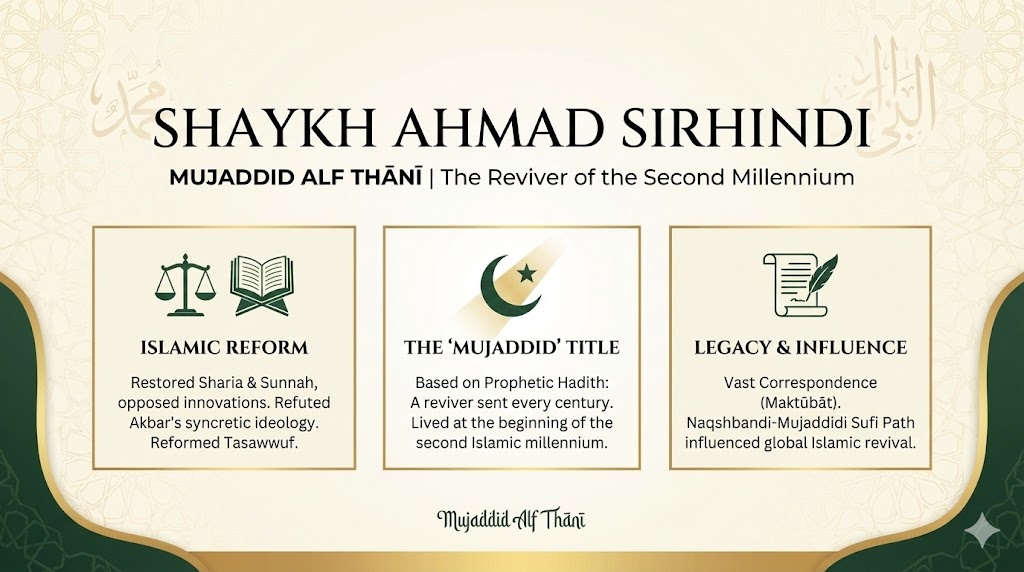
In Ṣafar 1034 AH, Shaykh Ahmad Sirhindī passed away in Sirhind. He is called “Mujaddid Alf Thānī.”
Biography and Historical Significance (971–1034 AH / 1564–1624 CE)
Early Life
- Full Name: Shaykh Ahmad ibn ‘Abd al-Aḥad al-Sirhindī al-Fārūqī
- Born: 971 AH / 1564 CE in Sirhind, Punjab (modern-day India)
- Lineage: Traced descent from ʿUmar ibn al-Khaṭṭāb (R.A.), hence the title al-Fārūqī
- Education: Memorized Qur’an, mastered Hadith, Tafsir, Fiqh (Hanafi), and studied under renowned scholars
Role in Islamic Reform
In the late Mughal period, India’s Muslim society faced severe challenges:
- Religious syncretism encouraged by Emperor Akbar under his Dīn-i Ilāhī policy, blending Hindu and Islamic elements
- Decline of Islamic scholarship and rise of un-Islamic customs among Muslims
- Influence of heterodox Sufism that deviated from Sharia
Shaykh Ahmad Sirhindī’s mission was to revive pure Islamic faith and practice:
- Restoring Sharia & Sunnah: Opposed innovations (bid‘ah) and un-Islamic court practices.
- Refuting Akbar’s syncretic ideology: After Akbar’s death, he advised Emperor Jahangir toward justice and religious adherence.
- Reforming Tasawwuf (Sufism): As a Naqshbandi Sufi master, he integrated deep spirituality with strict Sharia compliance.
- Strengthening Islamic identity: Revived confidence among Muslims—especially scholars—to resist cultural dilution.
Why He Was Called “Mujaddid Alf Thānī”
- Meaning: The Reviver (Renewer) of the Second Millennium
- Islamic Basis: The Prophet ﷺ said:
“Allah will raise for this Ummah at the head of every hundred years someone who will renew its religion.” (Abu Dawud, 4291)
Shaykh Ahmad lived at the beginning of the second Islamic millennium (1000 AH onwards). His revival efforts in belief, Sharia, and Tasawwuf earned him the title Mujaddid Alf Thānī.
Final Years and Passing
- He continued teaching, writing, and guiding disciples until his death in Ṣafar 1034 AH / December 1624 CE in Sirhind.
- He was buried in Sirhind Sharif, which became a major spiritual center in the Indian subcontinent.
Legacy
- Left behind vast correspondence: Maktūbāt-e-Imām Rabbānī, containing spiritual and reformist advice.
- His Naqshbandi-Mujaddidi path influenced Islamic revival movements in India, Central Asia, and beyond.
- Respected across Sunni scholarly traditions for courage and scholarship.