Reviving Iqbal’s Dream
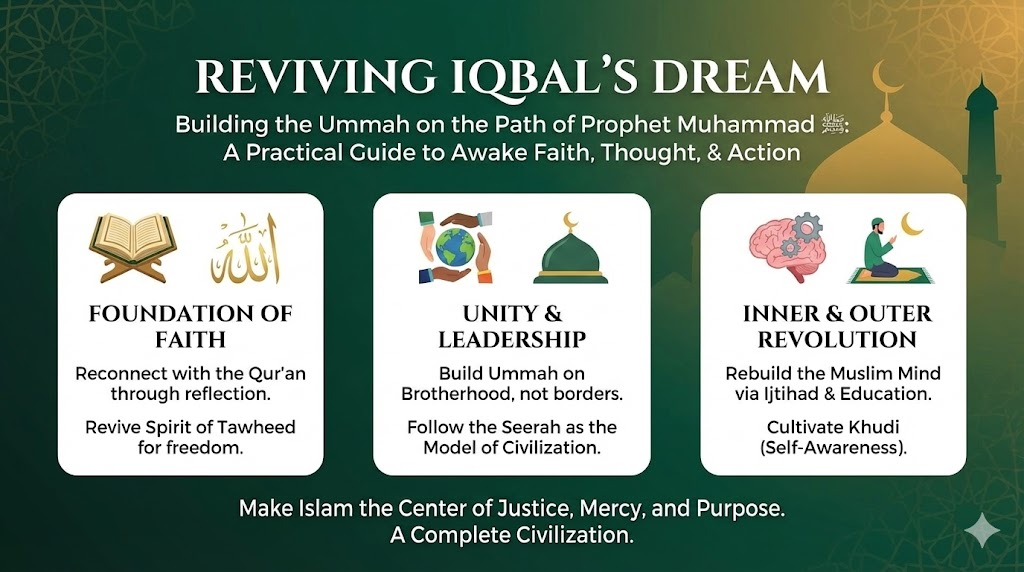
Building the Ummah on the path of Prophet Muhammad ﷺ requires more than emotion — it requires a disciplined return to divine guidance, moral courage, and purposeful action. Iqbal believed decline began when the Qur’an became a book of recitation only, not reflection.
1) Reconnect with the Qur’an as a Living Guide
Iqbal believed the decline of Muslims began when the Qur’an became a book of recitation only, not reflection.
- Teach Qur’an with tafakkur (reflection) and tadabbur (deep thought).
- Integrate its guidance into education, leadership, and personal ethics.
- Rebuild institutions where knowledge and spirituality go hand in hand.
2) Revive the Spirit of Tawheed (Oneness of Allah)
For Iqbal, Tawheed was not just belief in one God — it was the foundation of freedom, dignity, and unity. It means no slavery to power, wealth, or culture — only to Allah.
- Free our minds from dependence on Western thought or materialism.
- Build confidence in our Islamic identity.
- Nurture self-respect (khudi) — awareness that “I am Allah’s servant, created with purpose.”
3) Build the Ummah on Brotherhood, Not Borders
Iqbal’s vision of the Ummah was global — not divided by race, nationalism, or politics.
- Promote unity through Qur’anic values, not political slogans.
- Support the oppressed (Palestine, Sudan, Kashmir) as one body.
- Teach youth that national pride should never overshadow loyalty to Allah and His Messenger ﷺ.
4) Follow the Seerah as the Model of Civilization
Iqbal saw in the Prophet ﷺ the perfect integration of faith, intellect, and action. He said: “The Prophet’s spiritual leadership is the answer to the world’s despair.”
- Model leadership, justice, and compassion on the Prophet’s example.
- Revive akhlaq (character), ‘adl (justice), and raḥmah (mercy) in all institutions.
- Teach youth not only the events of Seerah, but how to live by its principles.
5) Rebuild the Muslim Mind — ‘Ijtihād’ and Education
Iqbal called Muslims to think — not just follow blindly.
- Reform education: blend spirituality, science, and ethics.
- Empower scholars who combine Islamic knowledge with modern insight.
- Encourage research rooted in faith — where the Qur’an inspires discovery.
6) Cultivate the Inner Revolution (Khudi)
Iqbal’s concept of Khudi is spiritual self-awareness that leads a believer to strength, purpose, and sincerity. It is not arrogance — it is knowing your worth before Allah.
- Train hearts through dhikr, salah, and reflection.
- Replace despair with action — “Arise and create your world.”
- Build youth who rely on Allah, not on systems or status.
7) Make Islam the Center — Not a Symbol
For Iqbal, Islam was not a set of rituals — it was a complete civilization of justice, mercy, and divine purpose.
- Anchor all reform — political, educational, social — in the Qur’an and Sunnah.
- Measure progress not by wealth or power, but by taqwa, compassion, and knowledge.
- Restore spiritual leadership rooted in sincerity and humility.
In Summary
Iqbal’s dream is awakened when the Ummah returns to Qur’an as guidance, Tawheed as liberation, Seerah as civilization, unity as identity, education as renewal, khudi as strength, and Islam as the living center. This is not nostalgia — it is a roadmap.