1) Refusing Bayʿah to Yazīd
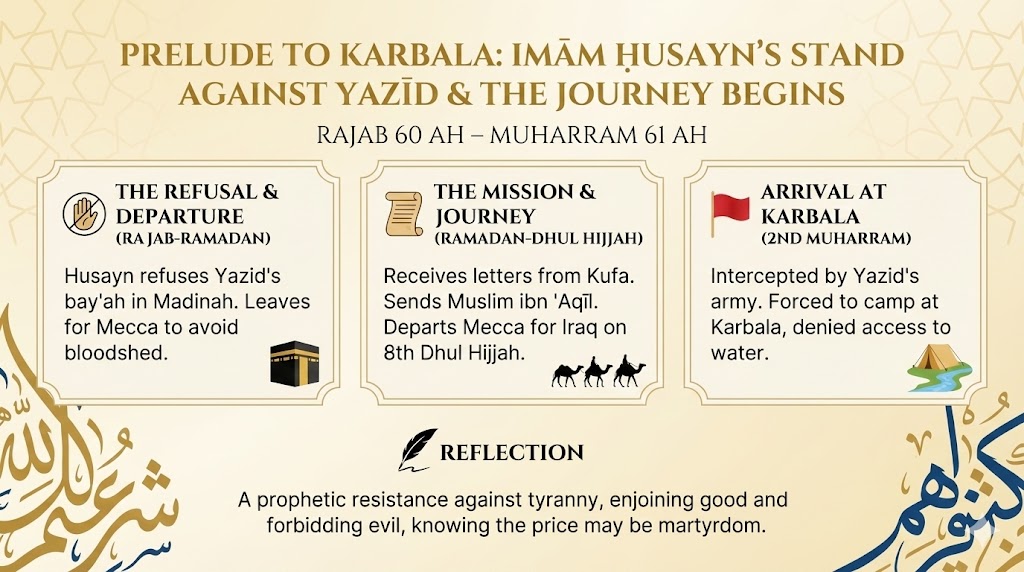
When Yazīd came to power, he instructed the governor of Madinah to demand bayʿah from Ḥusayn ibn ʿAlī immediately—threatening execution upon refusal.
“Someone like me does not give bayʿah to someone like Yazīd.”
To avoid bloodshed in Madinah, Imām Ḥusayn (A.S.) departed quietly with his family toward Makkah.
2) In Makkah: Letters from Kufa
In Makkah, people gathered around him and he received many letters from Kufa urging him to come as their leader, claiming they had no Imām and would support him.
3) Muslim ibn ʿAqīl Sent to Verify
Ḥusayn (A.S.) sent his cousin Muslim ibn ʿAqīl to test Kufa’s sincerity. Thousands initially pledged support, and Muslim wrote back encouraging Ḥusayn to come.
4) Betrayal in Kufa
Yazīd appointed ʿUbaydullāh ibn Ziyād over Kufa, who terrorized the city, captured Muslim, and executed him publicly on the Day of ʿArafah (9th Dhul Hijjah 60 AH). Ḥusayn (A.S.) was still in Makkah and unaware of how quickly the city had turned.
5) Leaving Makkah (8th Dhul Hijjah – Yawm al-Tarwiyah)
Despite warnings, Ḥusayn (A.S.) left Makkah before Hajj began to prevent fighting at the Sacred House.
“By Allah, I am not rising out of arrogance or rebellion, but to reform the Ummah of my grandfather ﷺ.”
6) The Road to Karbala
On the journey north, news of Muslim’s martyrdom and Kufan betrayal reached the caravan. Many urged turning back, but Ḥusayn (A.S.) remained firm:
“A believer does not fear death when he stands with truth.”
Reflection
This was not a political ambition—it was a prophetic stand against tyranny, to revive enjoining good and forbidding evil, even at the price of sacrifice.