Who Was Hishām ibn ‘Abd al-Raḥmān?
- Full name: Abū al-Walīd Hishām ibn ‘Abd al-Raḥmān al-Dākhil.
- 2nd Emir of Córdoba (al-Andalus).
- Reign: 172–180 AH (788–796 CE).
- Son of ‘Abd al-Raḥmān I (al-Dākhil), founder of the Umayyad Emirate in al-Andalus.
Key Aspects of His Rule
Religious Character
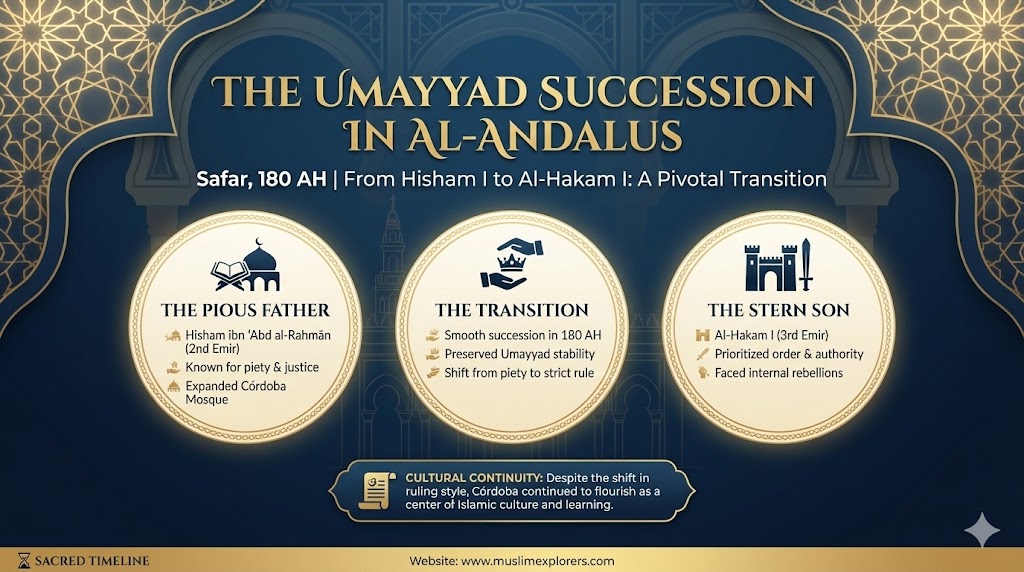
- Known for personal piety and justice.
- Encouraged Islamic scholarship.
- Expanded the Mosque of Córdoba significantly, laying groundwork for later grandeur.
Political Stability
- Continued centralization of power.
- Strengthened Córdoba’s authority over provinces.
Military Campaigns
- Conducted seasonal jihād (raids) against Christian kingdoms in northern Iberia.
- Defended Muslim rule from internal rebellions.
- Balanced Arab and Berber factions.
Death and Succession
- Died: Ṣafar, 180 AH (796 CE) in Córdoba.
- Succession: His son al-Ḥakam I (ibn Hishām) became 3rd Emir of Córdoba.
- The transition was smooth, though later turbulence emerged under al-Ḥakam.
Who Was al-Ḥakam I?
- Full name: al-Ḥakam ibn Hishām al-Rabḍī.
- Reign: 180–206 AH (796–822 CE).
- Known for strict and sometimes harsh rule.
- Suppressed the “Revolt of the Suburb” (Fitnat al-Rabḍ) in 202 AH; rebels were exiled as far as North Africa and Alexandria.
- Continued architectural development of Córdoba Mosque.
Importance of This Transition
- From a pious father to a stern ruler: Hishām remembered for devotion and fairness; al-Ḥakam prioritized authority.
- Stability of the Emirate: Dynastic continuity preserved Umayyad rule in al-Andalus.
- Cultural continuity: Córdoba Mosque remained a growing center of learning and Islamic culture.