Historical Context
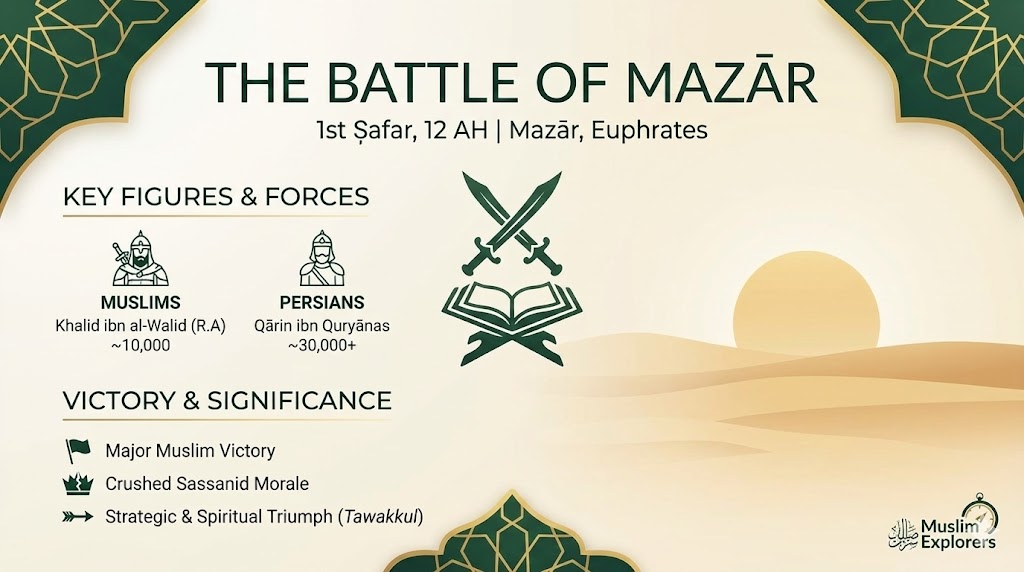
After a series of successful Muslim campaigns in Iraq, the Sassanid Persian Empire grew alarmed by the rapid expansion of Islam. To halt the advance, they dispatched a powerful army under the general Qārin ibn Quryānas to confront the Muslims at Mazār, near modern-day Kufa.
The Opposing Forces
The Muslim army, numbering approximately 10,000 soldiers, was commanded by Ḥaḍrat Khālid ibn al-Walīd (R.A.), known as the Sword of Allah. The Persian forces, estimated at around 30,000, were heavily armored and supported by allied Arab tribes.
The Battle Unfolds
Despite being heavily outnumbered, Khālid ibn al-Walīd employed superior mobility, battlefield intelligence, and tactical precision. Confident in numbers and armor, Qārin underestimated the resolve and faith of the Muslims.
The Muslim forces launched a fierce, fast-moving assault that broke through Persian lines. Qārin ibn Quryānas was killed in combat, triggering panic and collapse within the Persian ranks. The enemy fled, abandoning weapons, armor, and spoils.
Aftermath and Impact
- A decisive Muslim victory
- Crushing of Persian morale in the region
- Opened the path for later victories at al-Walaja and al-Anbār
Khālid distributed the spoils fairly among the soldiers. News of the defeat sent shockwaves through the Sassanid court and marked the beginning of the end of Persian dominance in Mesopotamia.
Spiritual Insight
The Battle of Mazār demonstrated that faith, discipline, and reliance upon Allah outweigh numerical superiority. It was a clear sign of divine support for a just cause.