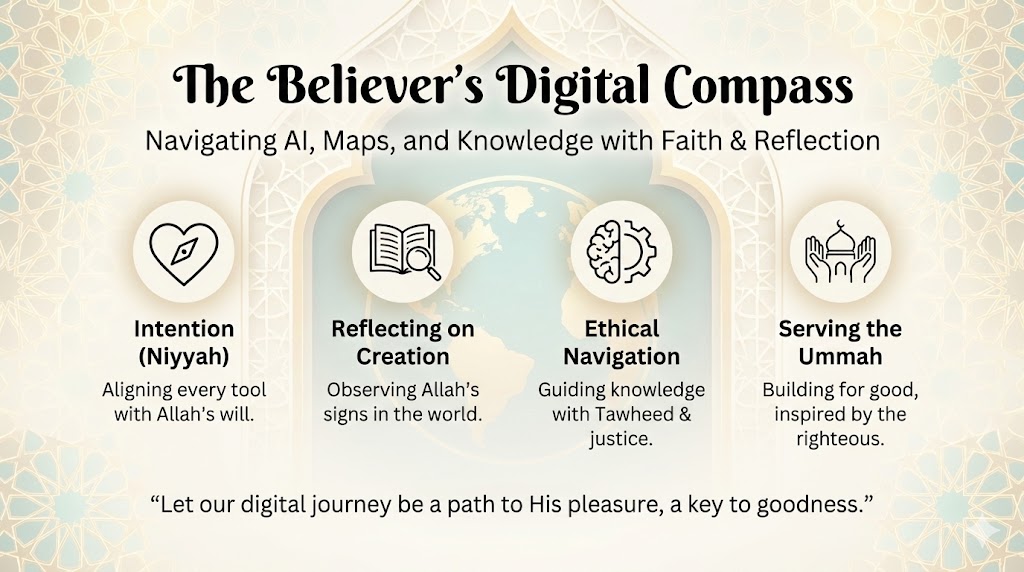
Maps Are More Than Navigation
Maps shape how we understand the world: where people live, how lands connect, and how resources, history, and identity are formed. For Muslims, geography also strengthens connection to the Ummah—from Makkah to Jakarta to Timbuktu.
Why It’s Important to Use Maps
- Understanding the world—relationships between land, people, and resources
- Strategic planning—travel, safety, and decision-making
- Preserving knowledge—maps record how civilizations saw the world
- Unity & identity—knowing the Ummah’s geography builds connection
- Da‘wah and trade—helps understand routes of peaceful spread
“It is He who made the earth tame for you—so walk among its slopes…” (67:15)
1) A Gateway to Reflecting on Allah’s Creation
“Do they not travel through the earth and observe how was the end of those before them?” (30:9)
A map can be the beginning of reflection—learning from civilizations and seeing the earth as signs (āyāt) of Allah.
“Indeed, in the creation of the heavens and the earth… are signs for those of understanding.” (3:190)
2) Serving the Ummah’s Revival
Muslim history shows mastery of geography for da‘wah, security, Hajj routes, and sciences like astronomy and qiblah direction.
3) Learning from the Travels of the Righteous
Ibn Battūṭah
His journey was for knowledge, worship, and da‘wah—observing the state of the Ummah across regions.
Al-Idrīsī
His mapping work served humanity through shared knowledge—geography as a unifying science.
4) Leaders and Strategy: Geography in Islamic History
- Hijrah: deliberate route planning with terrain knowledge
- Badr: strategic positioning near wells
- Khandaq: analyzing Medina’s geography and weak points
- Caliphate & empires: roads, postal stations, registers, and administration
5) Maps and AI Today
Geospatial maps empower self-driving cars, drones, and smart cities. Conceptual “mapping” supports neural networks, knowledge graphs, and language understanding.
The Key Principle: Niyyah Is the Qiblah
If AI is a modern “compass,” then your intention (niyyah) is the direction that makes it pleasing to Allah.
“Indeed, actions are but by intentions…” (Bukhari & Muslim)
Examples of Righteous AI Use
- Islamic learning tools (Qur’an, memorization, Q&A)
- Humanitarian mapping (poverty, relief distribution)
- Fighting injustice (bias detection, truth dissemination)
- Environmental care (water optimization, pollution monitoring)
A Du‘ā for Technology
“O Allah, make me a key to goodness and a lock against evil.”
Summary
- AI = Compass (shows paths)
- Niyyah = Qiblah (chooses the pleasing path)
- Mapping = Wisdom (organizing knowledge with purpose)