A Moment Frozen in Eternity
While teaching the hadith "He whose last words are 'La ilaha illa Allah' will enter Jannah," the Shaykh of Seiyun paused at those very words—La ilaha illa Allah—and his soul left this world.
He did not complete the narration with his tongue. But he completed it with his state, his truthful life, and his seal of sincerity.
This is not just a story. It is a mirror held up to every believer, asking: What will your last moment reveal about your life?
The Hadith That Became His Reality
The Prophet ﷺ said: "He whose last words are 'La ilaha illa Allah' will enter Jannah." This narration, found in Abu Dawud and authenticated by scholars, promises Paradise to those who depart with the testimony of faith on their lips.
But the Shaykh's story teaches us something deeper—that this final utterance is not a random occurrence. It is the culmination of a life lived in devotion to that very truth.
Death Reflects the Life You Lived
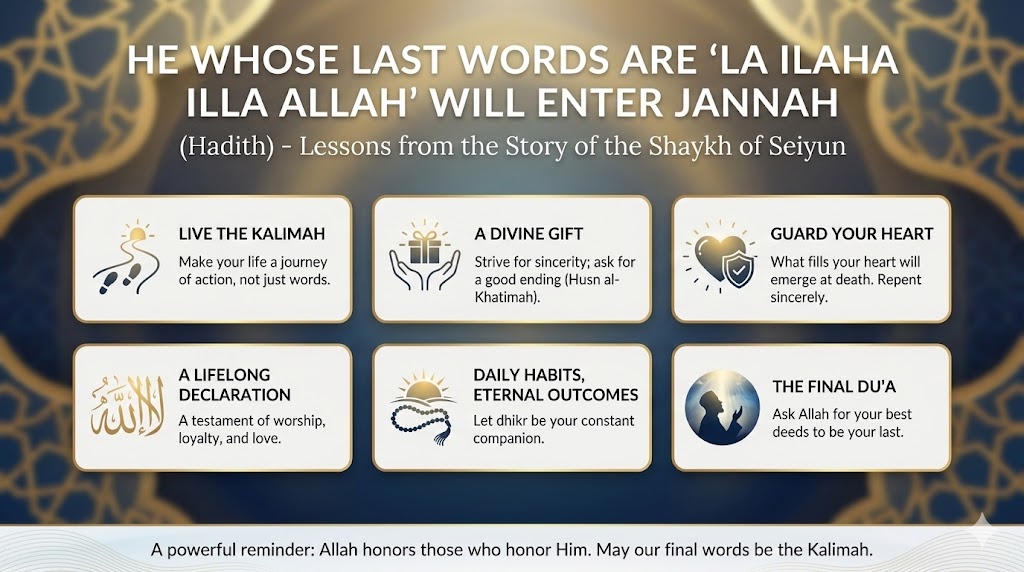
The Shaykh had spent his entire life living the kalimah—honoring it, preaching it, and remembering it. He taught it to others, reflected on its meanings, and allowed it to shape his actions and priorities.
So when death arrived, it flowed from his being naturally, effortlessly. Not just from his tongue, but from his very soul.
There is a profound spiritual principle here: You live upon what you love, and you die upon what you lived.
If your life is filled with dhikr, the Qur'an, prayer, and consciousness of Allah, then these will be present at your death. But if your days are consumed by heedlessness, entertainment, and distraction, what guarantee do you have that your tongue will serve you in that final, crucial moment?
Ḥusn al-Khātimah: A Divine Gift
The Shaykh was blessed with what we call ḥusn al-khātimah—a good ending. He died while teaching, while mentioning Allah, and in a state of peace. This is one of the greatest signs of Allah's acceptance and mercy.
But here is the humbling reality: a good ending cannot be earned by deeds alone. It is ultimately a divine gift, granted by Allah's mercy to those He loves.
Our role is to strive for sincerity, guard our hearts, and constantly make duʿāʾ that Allah grants us a beautiful departure from this world. We plant the seeds through our actions, but only Allah brings forth the harvest.
What You Fill Your Heart With Emerges at Death
Scholars have noted something troubling: there are those who, at the moment of death, are unable to say "La ilaha illa Allah." Their tongues refuse to form the words, or their minds become clouded.
What blocks them? Often, it is the weight of persistent, unrepented sins—especially sins of the eyes. Haram gazes, lustful images, and the poison of what we allowed ourselves to see repeatedly.
The eye is the window to the heart. What you permit to enter through your gaze becomes embedded in your soul. When the heart is not soaked in the kalimah but stained by desires and distractions, the tongue may fail you when you need it most.
This is why guarding the gaze is not a minor matter. Every glance matters. Every moment of restraint builds purity. Every act of repentance cleanses the heart so that your tongue may serve you faithfully at death.
The Kalimah Is Not Just Verbal—But Spiritual
"La ilaha illa Allah" is not merely a phrase to recite. It is a lifelong declaration of worship, surrender, loyalty, and love for Allah alone.
It means: I recognize no authority above Allah. I place my trust in Him alone. I shape my life according to His guidance. I love what He loves and reject what He rejects.
The Shaykh lived this meaning deeply. And so, at the moment of his death, Allah honored him by allowing him to embody it one final time—not through effort, but through grace.
Ask yourself honestly: Do I live "La ilaha illa Allah"? Or is it only on my tongue during prayer and difficulty?
Daily Habits Shape Eternal Outcomes
The Shaykh frequently recited the kalimah. He taught it, pondered it, and made it the center of his spiritual practice. This habit became his ending.
He was prepared, even though he did not know the exact moment death would arrive. His preparation was not last-minute panic—it was the accumulated result of decades of devotion.
This is the power of consistency. Train your soul every day to remember Allah. Let dhikr become your constant companion. Especially the words "La ilaha illa Allah"—repeat them in the morning, throughout the day, before sleep.
Your daily routine is building your eternal destiny, brick by brick, breath by breath.
A Duʿāʾ for a Good Ending
Make this supplication part of your regular worship:
Allāhumma ajʿal khayra aʿmālinā khawātīmahā, wa khayra ayyāminā yawma nalqāk, wajʿal ākhira kalāminā lā ilāha illā Allāh.
"O Allah, make the best of our deeds the last of them, and the best of our days the Day we meet You, and make our final words in this life 'La ilaha illa Allah.'"
A Reminder and a Warning
This story carries both comfort and caution.
It is a reminder that Allah honors those who honor Him. When you dedicate your life to His remembrance, He does not abandon you in your final breath.
And it is a warning that heedlessness and unrepented sins can cost us the most critical moment of our existence—the moment when the soul departs and our eternal fate is sealed.
The choice before us is clear. Will we live in a way that prepares us for that moment? Or will we gamble with eternity, assuming we have time we may not possess?
A Prayer for Us All
May Allah purify our hearts from every stain. May He protect our gazes from what displeases Him. May He forgive our slips and accept our repentance. And may He allow our souls to return to Him with "La ilaha illa Allah" flowing through our final breath.
Ameen, ya Rabb al-ʿĀlamīn.