The Heart That Turns
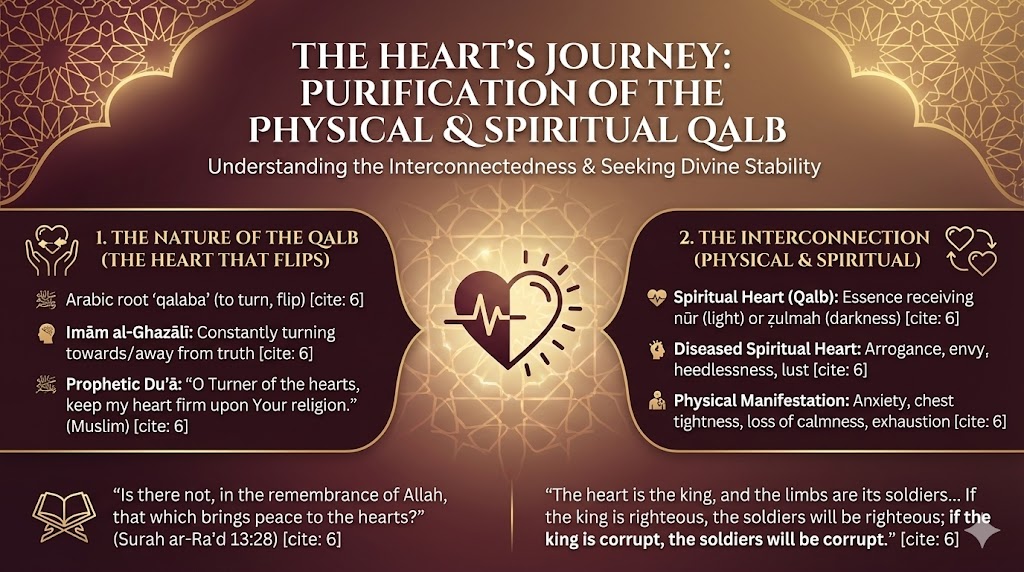
The Arabic word qalb (قلب) comes from the root qalaba, meaning to turn, flip, or change direction. This linguistic origin reveals a profound spiritual reality: the heart is never static. It moves between states — toward truth and away from it — often within the same day.
Imām al-Ghazālī explains in Iḥyā’ ʿUlūm ad-Dīn that the heart is named for its constant turning. This is why spiritual vigilance is essential; neglect allows the heart to drift, while remembrance anchors it.
The Prophetic Duʿā’ for the Heart
The Prophet Muhammad ﷺ frequently made the duʿā’:
“O Turner of the hearts, keep my heart firm upon Your religion.” (Muslim)
If the Messenger of Allah ﷺ — whose heart was the most illuminated — sought firmness, how much more do we require it? This supplication teaches humility and awareness of the heart’s vulnerability.
The Interconnection of the Spiritual and Physical Heart
Classical scholars such as Imām al-Ghazālī and Imām Ibn al-Qayyim affirmed that the spiritual heart (qalb) and the physical heart are mysteriously intertwined. The spiritual heart is the subtle center that receives nūr (light) or ẓulmah (darkness) depending on one’s inner state.
When the Spiritual Heart Is Diseased
When the qalb is afflicted by arrogance, envy, heedlessness, or unchecked desire, its effects do not remain abstract. They manifest physically as anxiety, tightness in the chest, emotional instability, loss of calmness, or even exhaustion.
This is why Islam does not separate spiritual health from physical well-being — the two influence each other continuously.
Peace Through the Remembrance of Allah
Allah states clearly:
“Is it not in the remembrance of Allah that hearts find rest?” (Surah ar-Raʿd 13:28)
Dhikr is not merely a ritual of the tongue; it is nourishment for the heart. When remembrance becomes consistent, the qalb regains balance, clarity, and tranquility.
The Heart as the King
Ibn al-Qayyim famously said in Madārij as-Sālikīn:
“The heart is the king, and the limbs are its soldiers. If the king is righteous, the soldiers will be righteous; if the king is corrupt, the soldiers will be corrupt.”
This principle explains why outward actions can never be fully corrected without inward purification. Reformation begins at the center — the heart.
The Beginning of Tazkiyah
The journey of tazkiyah begins with recognizing the heart’s nature, guarding it through remembrance, and continuously asking Allah for firmness. A heart that is nurtured with dhikr, humility, and awareness becomes a vessel for divine light — and from it flows righteous action.