Why Does Allah Mention Physical Phenomena?
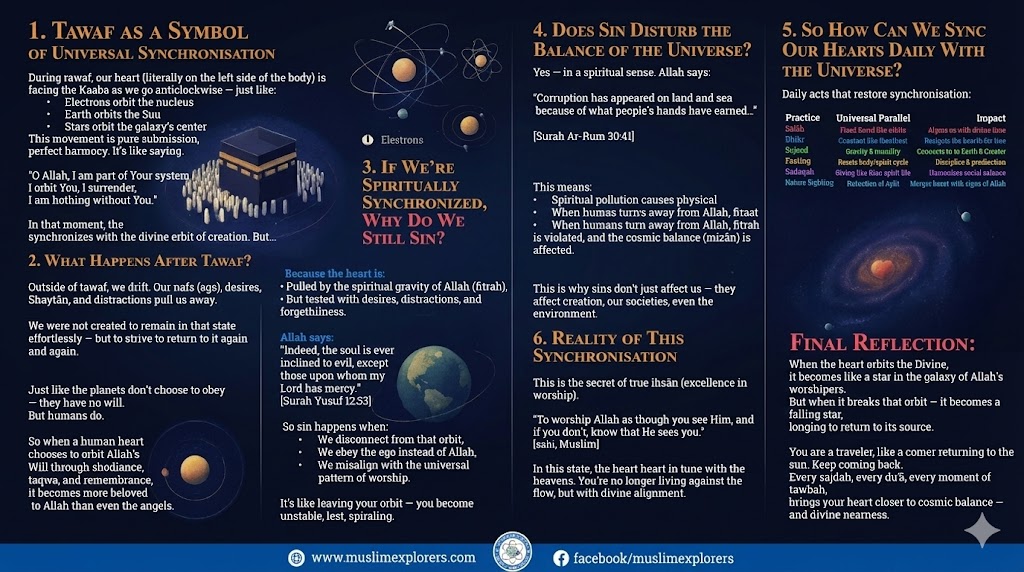
Allah mentions natural phenomena in the Quran for deeply meaningful reasons—not merely for scientific interest, but to awaken faith, reflection, and humility in the human heart. Every mention of rain, mountains, stars, or the human embryo serves a profound spiritual purpose.
1. To Invite Reflection (Tafakkur)
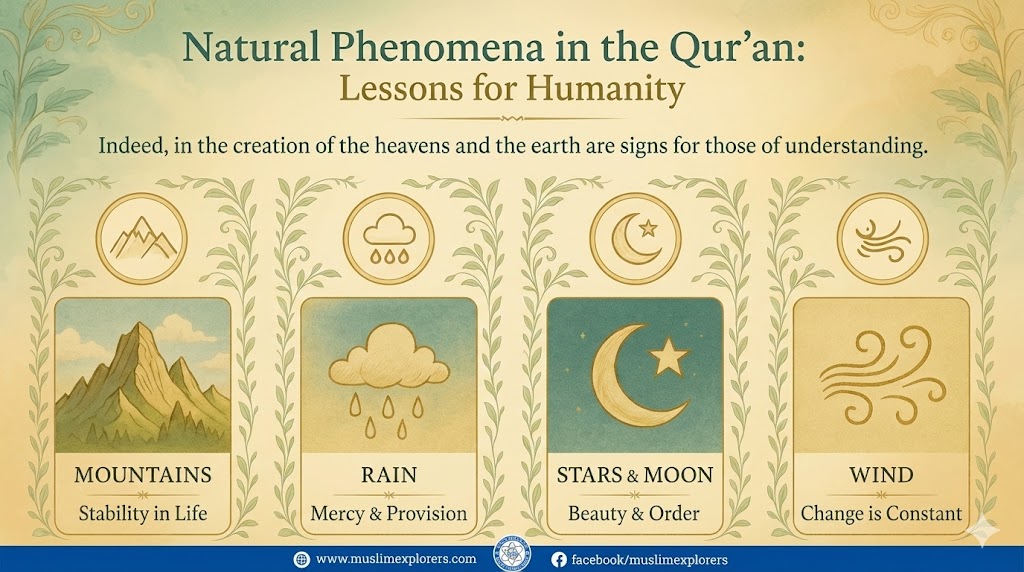
Allah declares: "Indeed, in the creation of the heavens and the earth... are signs for those of understanding." (Surah Aal-Imran 3:190)
Allah points to the skies, mountains, rain, animals, and stars as signs (ayat) of His existence, power, and wisdom. These aren't random details—they are proofs of Divine design. Every natural phenomenon becomes a window into understanding the Creator.
2. To Strengthen Iman Through Observation
When a believer observes the precision of the solar system, watches the formation of rain clouds, or studies the miraculous creation of the human embryo, it becomes impossible to deny a Creator.
The Universe as Witness
Every phenomenon becomes a spiritual witness to Allah's Rububiyyah (Lordship). The more we study creation, the more we see the fingerprints of the Divine Artist on every atom and galaxy.
3. Linking the Seen (Dunya) to the Unseen (Akhirah)
Allah uses natural phenomena as metaphors and analogies to help us understand spiritual realities:
Rain is compared to resurrection—just as dead earth is brought back to life with water, so too will dead bodies be resurrected on the Day of Judgment.
Night and day serve as metaphors for trials and relief, darkness and guidance, hardship and ease.
Winds and ships reflect divine control over apparent randomness, showing that what seems chaotic is actually under perfect divine management.
4. To Encourage Humility
When we ponder the vastness of space or the complexity of DNA, it reminds us of three humbling truths: We are small in the grand scheme of creation, we are completely dependent on Allah for every breath and heartbeat, and Allah alone is Al-Aleem (All-Knowing) and Al-Khaliq (The Creator).
This realization removes arrogance from the heart and builds genuine submission to the Divine will.
5. To Motivate Knowledge and Exploration
The Quran repeatedly asks: "Do they not look...?" (Afala yanzurun). This divine question inspired early Muslims to become pioneers in astronomy, medicine, botany, and physics.
The Islamic Approach to Science
Islam encouraged scientific progress not as an end in itself, but as a way to appreciate Allah more deeply. Everything in the universe becomes a teacher when viewed through the lens of faith.
The Book of Nature and Book of Revelation
If we read the "book of nature" with the same reverence as the "Book of Revelation," we discover a profound truth: Science reveals the how—the mechanisms and processes. Revelation explains the why—the purpose and meaning.
Both books come from the same Author, and when read together, they create a complete picture of reality.
Conclusion: Every Sign is an Ayah
Next time you feel the breeze on your face, watch a bird soar through the sky, or gaze up at the stars scattered across the night sky—remember: You're looking at an ayah, a sign from Allah. Each natural phenomenon is a verse in the cosmic book, inviting you to know your Creator more deeply.