Meaning and Essence
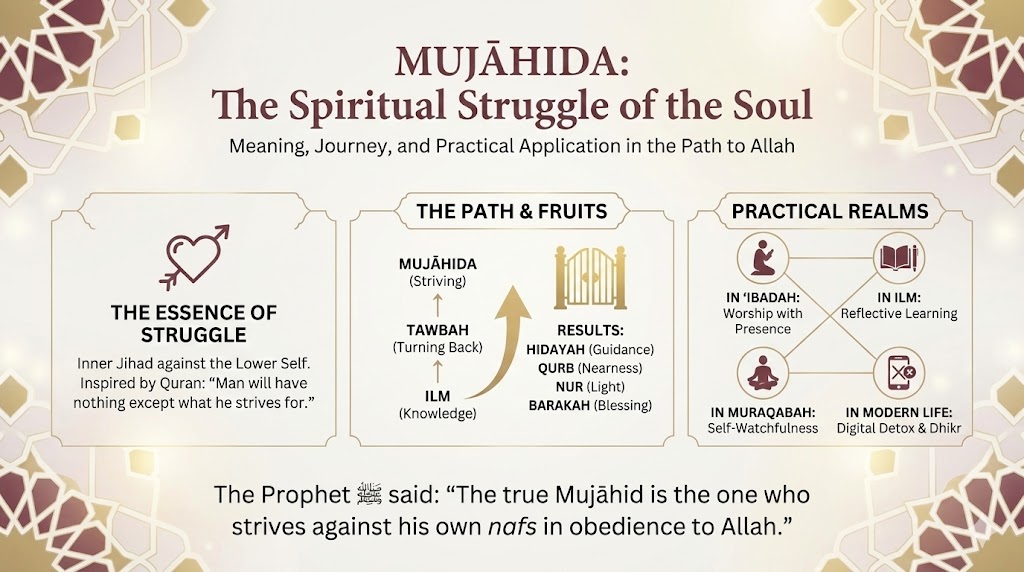
Mujāhida (مجاهدة) comes from the root j-h-d, meaning to strive, exert, or struggle. It is the inner jihād — the ongoing battle of the believer against the lower self (nafs al-ammārah) that calls toward disobedience, laziness, ego, and heedlessness.
“Man will have nothing except what he strives for.” (Surah An-Najm, 53:39)
This is the foundation of Mujāhida: no purification, no nearness, no taqwa without effort.
The Place of Mujāhida in Tazkiyah
In the cycle of purification, Mujāhida comes after ‘Ilm (knowledge) and Tawbah (turning back). Without Mujāhida, both ‘Ilm and Tawbah remain ideas — unfulfilled.
The Core Sequence
- ‘Ilm: Knowing the truth → Awareness
- Tawbah: Turning back to Allah → Purification
- Mujāhida: Striving for Allah → Transformation
- Result: A purified Qalb → Qurb
Striving Against the Nafs
The Prophet ﷺ said: “The true Mujāhid is the one who strives against his own nafs in obedience to Allah.” (Aḥmad)
There are four primary levels of this struggle:
- Striving to learn truth (‘Ilm)
- Striving to act upon truth (‘Amal)
- Striving to call others to truth (Da‘wah)
- Striving to remain patient upon truth (Ṣabr)
These four complete the circle of purification.
The Nature of Spiritual Effort
Every act of worship (‘ibādah) — from ṣalāh to du‘ā’, from fasting to forgiveness — is an exercise in Mujāhida. The soul strengthens through consistent struggle.
- To control anger when provoked.
- To forgive when wronged.
- To wake for Fajr despite sleep.
- To say “Alhamdulillah” when tested.
Each of these is spiritual weightlifting.
Fruits of Mujāhida
“Those who strive in Us, We shall surely guide them to Our paths.” (Surah Al-‘Ankabūt, 29:69)
- Hidāyah (Guidance): Doors of understanding open effortlessly.
- Qurb (Nearness): The heart begins to feel Allah’s presence.
- Nūr (Light): Clarity replaces confusion.
- Barakah (Blessing): Time, effort, and rizq become full of divine goodness.
Practical Realms of Mujāhida
Mujāhida in ‘Ibādah
- Perform obligatory acts with presence (khushū‘).
- Add small, consistent voluntary acts (Sunnah, nawāfil).
Mujāhida in ‘Ilm
- Reflect daily: “What have I learnt that changed me?”
- Avoid knowledge that feeds pride or argumentation.
Mujāhida in Du‘ā’ and Wird
- Maintain morning and evening adhkār.
- Consistently seek forgiveness (istighfār).
Mujāhida in Muraqabah and Muḥāsabah
- Muraqabah: self-watchfulness — be aware Allah sees you.
- Muḥāsabah: self-accounting — daily review of heart, words, and actions.
Mujāhida in Modern Life
- Digital detox: limit distractions, avoid idle scrolling.
- Replace online noise with Qur’an, dhikr, and silence.
The Uphill Journey
Mujāhida feels difficult because it is uphill. But Allah has placed spiritual energy in every sincere struggle. When you resist the pull of the nafs, you store light in the heart.
The more you struggle for Allah, the more you rise. When you give in to laziness, ego, or indulgence, you descend. This is the unseen law of spiritual gravity.
The Secret of Divine Assistance
When the servant takes a single step toward Allah, Allah multiplies it with infinite support. Each act of Mujāhida brings tawfīq — divine enablement.
In a hadith qudsī: “My servant continues to draw near to Me with voluntary acts until I love him. When I love him, I become his hearing with which he hears, his sight with which he sees, his hand with which he grasps, and his foot with which he walks.” (Bukhari)
In Summary
Mujāhida transforms knowledge into reality and repentance into change. It is the furnace where the soul is refined, the heart is polished, and the believer is raised to qurb. Without Mujāhida, tazkiyah remains an idea; with it, the heart becomes a living witness of Allah’s guidance.