The Origins of the Sacred Pilgrimage
Islamic sources make beautifully clear that Hajj—as the specific series of rites we perform today—originates with our father Ibrahim (peace be upon him). Understanding how the lineage of Prophets relates to Hajj deepens our appreciation for this sacred journey.
1. Adam: The First House
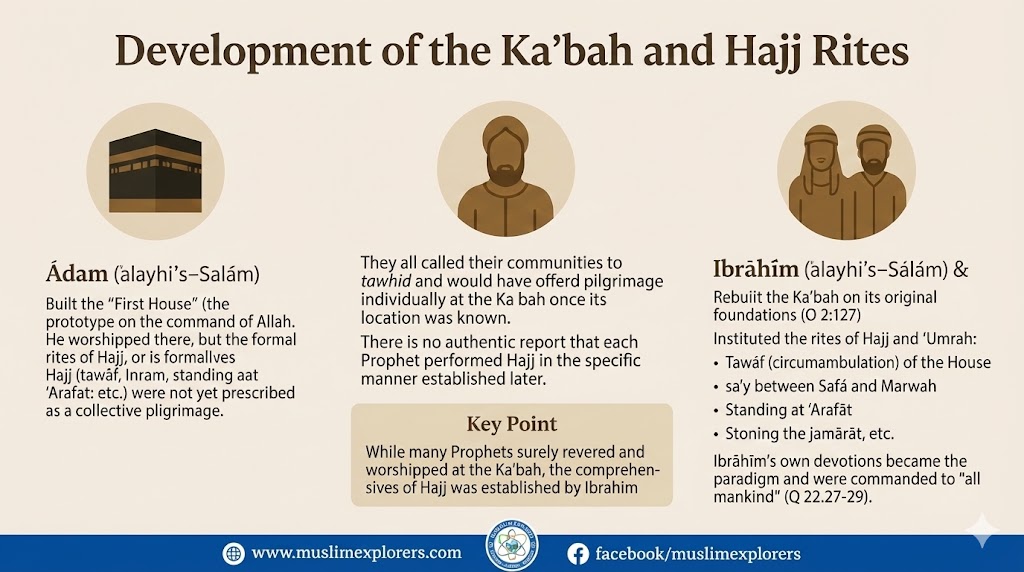
Prophet Adam (peace be upon him) built the "First House" (the prototype of the Kaaba) on direct command from Allah. He worshipped there in devoted submission, but the formal rites of Hajj—tawaf, ihram, standing at Arafat, and other rituals—were not yet prescribed as a collective pilgrimage.
Adam's building reminds us of the primal human yearning to return to Allah, establishing the Kaaba as the spiritual anchor for all future generations.
2. The Early Prophets: Individual Devotion
Prophets Nuh, Hud, Salih, Lut, and other early messengers all called their communities to pure tawhid. They would have offered individual pilgrimage at the Kaaba once its location was known, though there is no authentic report that each Prophet performed Hajj in the specific comprehensive manner established later.
Their visits to the sanctuary reflect the universal pattern of individual devotion to Allah at His chosen house.
3. Ibrahim and Ismail: Establishing the Universal Pilgrimage
Prophet Ibrahim and his son Ismail (peace be upon them both) rebuilt the Kaaba on its original ancient foundations, as Allah mentions: "And when Ibrahim was raising the foundations of the House with Ismail..." (Quran 2:127)
The Comprehensive Rites Instituted
They instituted the complete rites of Hajj and Umrah that Muslims perform today: Tawaf (circumambulation) of the House, Sa'y between Safa and Marwah, standing at Arafat in humble supplication, stoning the jamarat, and other sacred rituals.
Ibrahim's own acts of devotion became the divine paradigm, commanded to "all mankind" as Allah declares: "And proclaim to the people the Hajj..." (Quran 22:27-29)
The Spiritual Lineage
While many Prophets surely revered and worshipped at the Kaaba, the comprehensive ritual of Hajj—in its complete seven days of ihram, tawaf, sa'y, standing at Arafat, and so on—was established by Ibrahim (peace be upon him) and then reaffirmed by Muhammad (peace and blessings be upon him) during Hijjat al-Wada.
Key Spiritual Reflections
Adam's building reminds us of the primal human return to Allah. Subsequent Prophets' visits to the sanctuary reflect individual devotion. Ibrahim's innovation of a universal pilgrimage symbolizes the unity of all believers under Tawhid.
The Prophet Muhammad's Simple Hajj
The Prophet Muhammad (peace and blessings be upon him), despite being the Beloved of Allah, Master of humanity, and leader of nations, performed Hajj in the most humble, simple, and spiritually immersed manner possible.
The Simplicity of Hijjat al-Wada
During his only Hajj, known as Hijjat al-Wada (The Farewell Pilgrimage), the Prophet wore two plain unstitched white garments (ihram) exactly like everyone else. He slept in open areas under the vast sky, walked among all people—rich and poor, black and white, Arab and non-Arab—as one unified Ummah.
He rode a simple camel named al-Qaswa, not seeking any special transport. He wept during dua, stood at Arafah with profound humility, and prayed with complete sincerity, showing the deepest submission to Allah.
"Take from me your rituals," he instructed (Hadith in Muslim), leaving a lasting legacy of humility, submission, and unity—never luxury, privilege, or division.
Examples from Wealthy Companions
Many wealthy Sahabah deliberately avoided privilege during Hajj, choosing to live the same simplicity as the poorest pilgrims:
Abd al-Rahman ibn Awf
One of the richest Companions, he would walk barefoot in Makkah and distribute his considerable wealth in secret. During Hajj, he mixed with the crowd, carried his own baggage, and deliberately avoided special treatment despite his immense wealth.
Umar ibn al-Khattab
The second Caliph, during Hajj, once saw people eating luxuriously in Mina and warned: "If this is your Hajj, what would your worldly life look like?" He cautioned against transforming spiritual rituals into displays of status and wealth.
Hasan al-Basri
From the generation after the Companions, he would teach: "The one whose Hajj is accepted is the one who returns with a broken heart and purified soul—not the one with the softest tent or most servants."
Does VIP Culture Affect Hajj's Spirituality?
Yes—when it leads to pride, showing off, or looking down on others. When it creates disconnection from the unity and equality Hajj is designed to foster. When it prioritizes comfort over contemplation and luxury over submission.
However, if someone uses better accommodations out of genuine necessity—elderly pilgrims, those with medical needs—without arrogance, it need not harm the spiritual essence, provided the heart remains humble.
Maintaining Spiritual Closeness During Hajj
1. Constantly Recall the Prophet's Humility
When you see VIP lounges and luxury accommodations, remember the Prophet sleeping on sand under the stars, completely content with simplicity.
2. Avoid All Comparisons
Hajj is exclusively between you and Allah—never about tents, hotel ratings, or social media posts. Your spiritual state matters infinitely more than your physical comfort.
3. Make Deep Dhikr in Silence
Especially at Arafah, Muzdalifah, and during Tawaf—pour your heart out to Allah in private conversation, away from cameras and crowds.
4. Serve Others Actively
Even if you're in comfortable accommodations, actively offer water to thirsty pilgrims, hold someone's hand on difficult terrain, smile warmly at workers—these acts multiply your reward exponentially.
5. Deliberately Shed Your Ego
Take intentional moments to disconnect from comfort: walk barefoot occasionally, sit on the ground for reflection, contemplate deeply like the Prophet did.
6. Weep—In Tears or In Heart
Cry for the suffering Ummah, for your accumulated sins, for Allah's infinite pleasure. Let your heart break open before your Lord.
Final Reflection: Hajj as Death Rehearsal
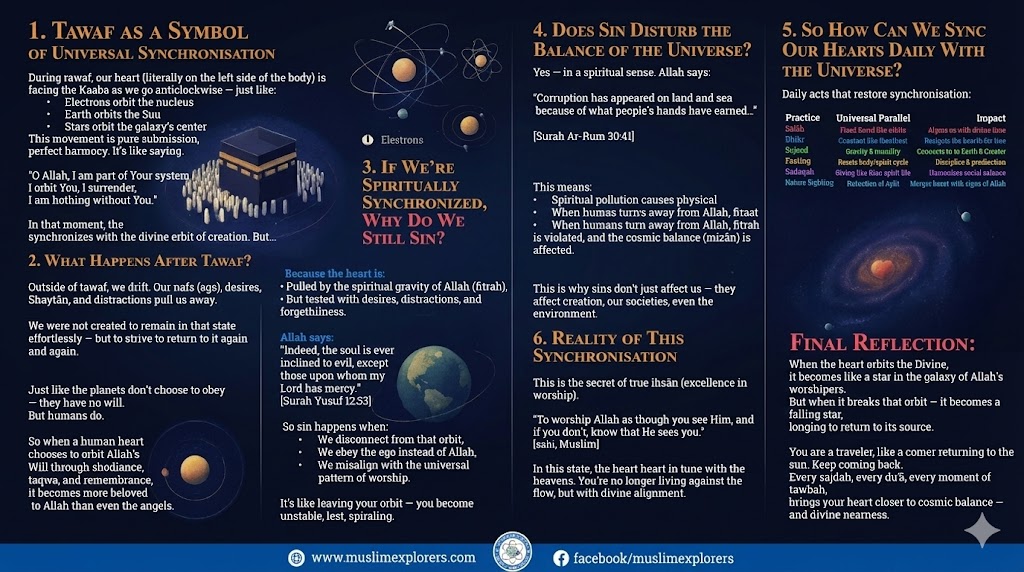
Hajj is not a tourism event or cultural experience. It is a profound death rehearsal preparing us for our ultimate journey:
Ihram is like the white shroud (kafan) we'll be wrapped in. The Hajj rituals mirror our journey to the Afterlife. Arafah resembles the Day of Judgment when all humanity stands before Allah. Tawaf reflects how angels constantly circle Allah's Throne in worship.
Conclusion: Returning to the Source
From Adam's first construction to Ibrahim's renewal to Muhammad's perfect demonstration—Hajj calls every generation to strip away labels, luxury, and layers, returning to our Lord with nothing but sincere need.
Let us proclaim with our entire being: "Labbaik Allahumma Labbaik..." (Here I am, O Allah, here I am. I have come to You with nothing but my desperate need for You). Ameen.