The Essence of ‘Ilm: Knowledge as Light
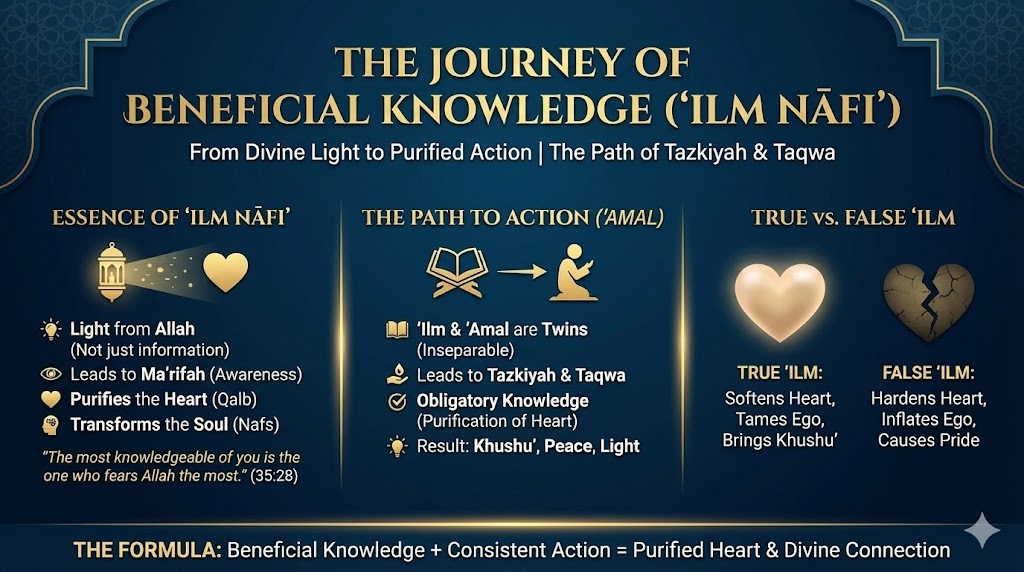
In Islam, ‘ilm is not merely information. It is a light from Allah that guides a person from jahālah (ignorance) to awareness, from confusion to clarity, and from heedlessness to sincerity. True ‘ilm is not meant to simply fill the mind — it is meant to purify the heart (qalb) and transform the soul (nafs).
“The most knowledgeable of you is the one who fears Allah the most.” (Surah Al-Fāṭir 35:28)
‘Ilm Leads to Ma‘rifah
Beneficial knowledge opens the heart to awareness (mushāhadah), increases khushū‘ in worship, and makes one feel Allah’s closeness both inwardly and outwardly.
- It opens the heart to awareness (mushāhadah) and deepens spiritual presence.
- It increases khushū‘ in worship and strengthens humility.
- Knowing who Allah is makes the servant humble.
- Knowing who I am leads to istighfār, because self-recognition exposes our dependence and need for mercy.
- It deepens the relationship with Allah through experiential awareness, not mere intellect.
Beneficial vs. Non-Beneficial Knowledge
The Prophet Muhammad ﷺ taught us that knowledge can be a gift or a trial:
“O Allah, I seek refuge in You from knowledge that does not benefit.” (Sunan Ibn Mājah, 250)
What is Beneficial Knowledge?
‘Ilm nāfi‘ (beneficial knowledge) is like spiritual nutrition — it strengthens the soul and transforms one’s inner state.
- Softens the qalb (heart)
- Tames the nafs (ego)
- Creates khushū‘ and awareness of Allah
- Leads to ‘amal ṣāliḥ (righteous action)
What is Non-Beneficial Knowledge?
Knowledge that does not move the heart, humble the ego, or draw one closer to Allah becomes like food that never nourishes.
- Inflates the ego
- Breeds argumentation
- Stays on the tongue, not the heart
- Leads to heedlessness (ghaflah)
A dangerous sign is when knowledge increases الكلام (talk) but does not increase du‘ā’ or sincerity: Allah does not answer the du‘ā’ of a heedless heart (qalb ghāfil). If our ‘ilm does not bring focus and sincerity in du‘ā’, it means the heart has not yet been nourished by it.
‘Ilm Must Lead to ‘Amal (Action)
There is no separation between knowledge and action. They are twins of faith — one calls, and the other must answer. Knowledge that stays in theory becomes a burden and can even become a proof (hujjah) against a person on the Day of Judgement.
Imam Abdul Qādir Jīlānī (رحمه الله) said: “Ilm calls out for Amal. If Amal responds, Ilm remains. If Amal does not respond, Ilm departs.”
The Path of Tazkiyah and Taqwa
Tazkiyah (purification) is the journey of refining the inner self until it aligns with what Allah loves. The first level of Taqwa is obedience to all that Allah has commanded and abstaining from all He has forbidden — both outwardly and inwardly.
- This is obligatory knowledge (‘ilm farḍ ‘ayn) for every believer.
- Learning to purify the heart from diseases such as pride, envy, anger, arrogance, and hypocrisy is not optional.
- Without purification, worship loses sincerity and light.
The Diet of Beneficial Knowledge
Just as the body needs daily nourishment, the soul needs a daily dose of beneficial ‘ilm. This includes:
- Reflecting on Allah’s Names and Attributes
- Reading the Qur’an with the heart
- Seeking understanding of the wājib (obligatory) knowledge first
- Constantly applying what one learns
“The most beloved deeds to Allah are those done consistently, even if small.” (Ṣaḥīḥ al-Bukhārī)
True ‘Ilm vs. False ‘Ilm
The difference can be seen in what it produces:
- Effect on Qalb: True ‘ilm brings khushū‘ and awareness; false ‘ilm causes pride and ghaflah.
- Connection with Allah: True ‘ilm deepens relationship; false ‘ilm weakens relationship.
- Effect on Nafs: True ‘ilm controls desires; false ‘ilm fuels desires.
- Leads to: True ‘ilm leads to ‘amal & istighfār; false ‘ilm leads to argument & ego.
- Result: True ‘ilm leads to taqwa, light, peace; false ‘ilm leads to darkness and distance.
In Summary
Beneficial knowledge is not measured by how much we know — but by how much we become closer to Allah through it. It is light that produces humility, repentance, sincerity, and action. When ‘ilm is truly beneficial, it reforms the heart, disciplines the nafs, and turns the believer into a living reflection of guidance.